The Lymph Method

The 7 simple frameworks that move the fluid, waste and inflammation your body has to clear every day, and decide how puffy, stiff and tired you feel at 60, 70 and 80. Built from Nature, Science, Lancet and JAMA research. Written in plain words. Designed to be used, not filed away.
If you've ever asked yourself any of these, quietly, looking at your ankles on an ordinary Tuesday night, you're not lazy, you're not vain, and you're not out of time.
You just don't know about the system that clears it yet.
Picture yourself at 70.
Waking up and recognising your own face. Walking every morning on legs that feel light. Carrying your own bags. Getting down on the floor with grandkids and back up again without a plan. Travelling, working, thinking clearly, because your body is still clearing its own waste every single night.
Now picture 80. Independent. Sharp. Ankles that fit your shoes at 6pm. Not counting pills. Still you. Just older.
That version of you is not luck. It's built.
And most of it is decided by what you do in your 50s and 60s, when the system that drains you starts to slow down.
Now picture the other version.
The one where you make it to 80, but the last 10 years are spent puffy, stiff and tired, in doctors' offices, on more medications, watching from a chair.
Not because you did anything wrong. But because no one ever showed you that your body has a second circulation with no heart of its own, that it clears the waste behind swelling, stiffness and quiet inflammation, and that it only moves when you move it.
Worldwide, the average person spends the last 9.6 years of their life in poor health. A large share of that is slow, quiet inflammation. Your lymph is the system that carries inflammation away.
Garmany and Terzic, JAMA Network Open, 2024. Franceschi et al., Nature Reviews Endocrinology, 2018.
The goal isn't more birthdays. It's more good years.
Seven levers on one system. Ordinary things, done daily.
Seven simple levers. One complete method.
Your drains aren't what you think.
Every day, about 3 litres of fluid leak out of your blood vessels into the spaces between your cells. Your blood has a heart to move it. The fluid coming back has none. It rides a second network of vessels, through 600 or so filtering nodes, powered only by your muscles, your breath and the pulse of the arteries next to it.
Sit for eight hours and that network barely moves. Fluid pools in the lowest places (your ankles) and the softest (under your eyes, along your jaw). The waste it was supposed to carry away sits there instead. With age the vessel walls weaken and leak, the nodes shrink, and the whole system gets slower at its one job. None of it is dramatic. None of it hurts. That's exactly why most people miss it.
In 2015, scientists found lymphatic vessels in the lining of the brain. The textbooks had said for a century that they did not exist.
Louveau et al., Nature, 2015. Da Mesquita et al., Nature, 2018.
The people who are still light, mobile and clear-headed at 80 aren't lucky. They quietly kept that system moving for decades, most of it free, none of it extreme.
The Lymph Method shows you exactly how.
the year lymph vessels were found in the brain, now a major focus of aging research
Nature, 2015lower blood-sugar spike from one seated calf move, in people who never left their chair
iScience, 2022more space opens between brain cells in deep sleep so waste can be flushed out
Science, 2013years the average person spends in poor health at the end of life
JAMA Network Open, 2024Here's what the research actually says.
The science is settled. What's missing is a simple, do-it-tomorrow system that most people never see until the sock lines are permanent.
You're seeing it now.

The Lymph Plate: salt down, potassium up, a palm of protein. Chapter 4.
Motivation is not the problem.
You've watched the face-massage videos. You've bought the dry brush, the tea, the compression socks. You know you should move more, eat less salt, sleep better.
The problem isn't information. It's order. Nobody has ever told you that the collarbones have to be opened before the face will drain, that your breath moves more lymph than any massage, or that a toast-and-sandwich day leaks water into your ankles because of a protein you've never heard of.
That's exactly what The Lymph Method gives you: 7 frameworks, in plain words, in the order your body actually drains, that you can run on your own body for the rest of your life.
That's the gap this guide closes.
Here's what changes when you have the actual method.
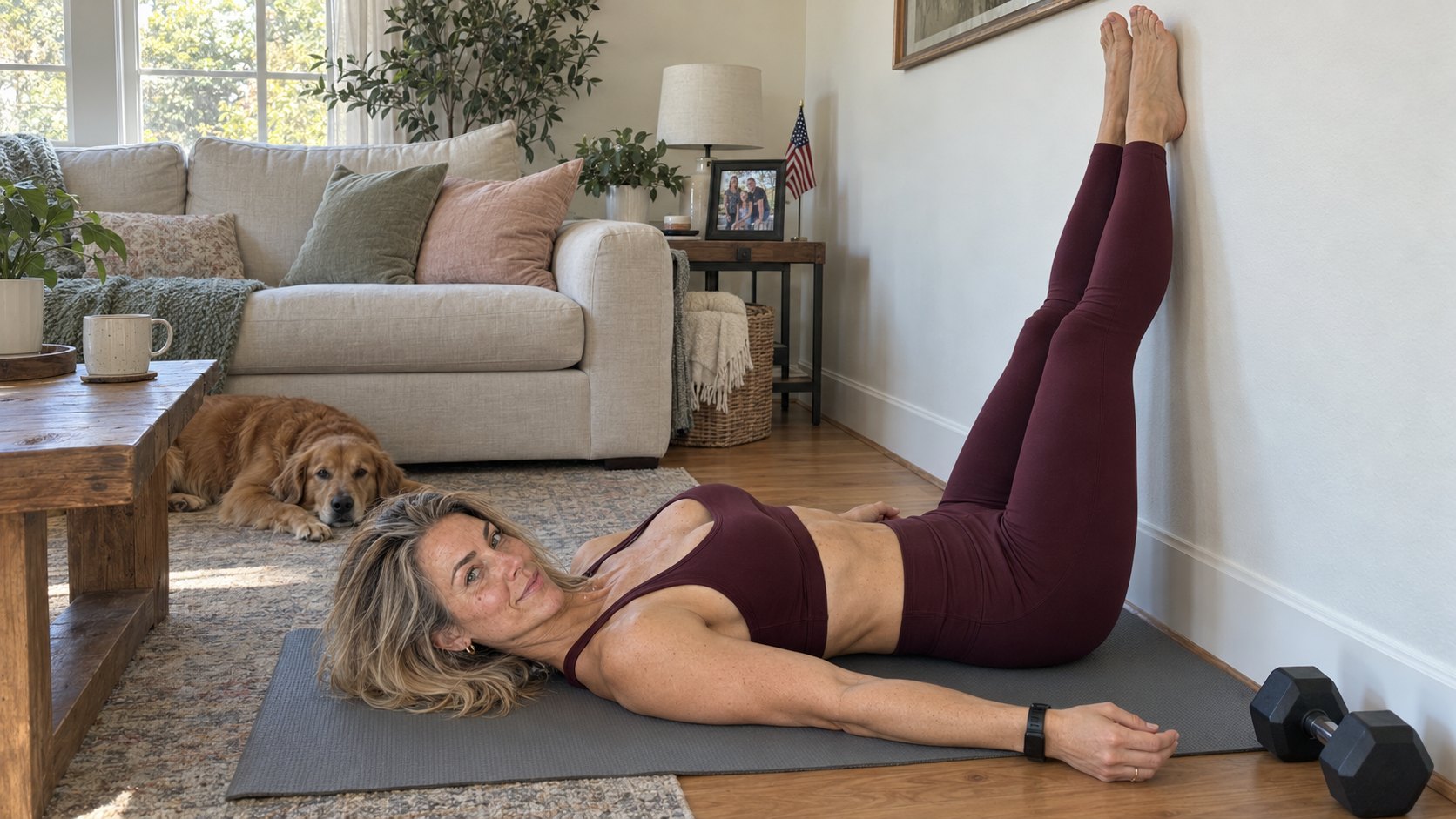
Ten minutes a morning. The Daily Drain, photographed step by step in Chapter 3.
Rated 4.9/5 by readers
What readers say after the first month
“I did face massage every single morning for a year off a video and nothing changed. The collarbone step was the missing piece. Two weeks in and I recognise my face again when I wake up.”
Linda, 61“Sock lines every evening for ten years. I thought that was just what 60 looked like. Twenty calf raises every hour at my desk and legs up the wall after dinner. Three weeks. Gone.”
Carol, 64“I bought dandelion root on its own before and it did nothing. The book explained why. Nothing was moving, so there was nowhere for the fluid to go. Doing the routine first made all the difference.”
Helen, 58“I'd been told my bloods were fine for years. The book said ask for TSH by name. My thyroid was slow. Years of puffy hands and face finally had a name. That one page was worth the price.”
Margaret, 66“Post menopause I just assumed the puffiness was my body now. It isn't. Salt down, potassium up and the ten minute morning routine, and my rings go on and off again by evening.”
Tanya, 56“I'd tried compression socks, elevation, the twelve exercises from Facebook, all of it. What I never had was the order. Open the exit first, then pump. It finally made sense and it finally worked.”
Sue, 59“Summer and long flights used to wreck my ankles. This year I did the ankle circles every hour and legs up the wall when I landed. First holiday in a decade where my shoes still fit on the last day.”
Patricia, 62“The red flags page sent me to my doctor about one swollen leg. It was nothing serious, but I would never have known the difference. I trust a book that tells you when it's not the answer.”
Joanne, 57“I'm a bloke and I didn't think any of this was for me. The sitting pump and the strength menu are the most practical health advice I've had since my forties. My ankles noticed before my face did.”
Dennis, 63“The photos are what sold me. Every move shows exactly where your fingers go. I've never once had to guess, which is more than I can say for every video I've watched.”
Anne, 70“The Lymph Plate is the part I use every week. I never used the salt shaker so I thought I was fine. It was the bread and the deli counter. Ankles down a full ring size.”
Frank, 60“Ten minutes a morning, no equipment, and I can see the difference in the mirror by lunch. I've sent it to both my sisters.”
Rosemary, 68The Lymph Method
7 chapters. 7 frameworks. One complete, science-backed system for draining better and aging well.
The Drain Check
Stop guessing where to start. In 15 minutes you'll know whether it's your face, your legs, your muscle, your sleep or your stress that is stalling you, so every hour you spend from here pays off double.
The Pump Menu
Your muscles are the only pump your lymph has. Six moves at your level, two days a week, plus the seated calf move that keeps it running from a chair.
The Daily Drain
Ten minutes, in the right order, every morning. Collarbones first, then the breath pump, then face, armpits and legs. And an honest verdict on dry brushing, rebounding and detox teas.
The Lymph Plate
Eat food you like, at any restaurant, on any budget, and still leave the table holding less water. Salt down, potassium up, a palm of protein. No meal plan, no cult diet, no guilt.
The Night Drain
Your brain cleans itself in deep sleep, and stress holds water. Fall asleep faster, wake up less puffy, and flip the calm switch in 60 seconds when life spikes.
Your Drain Dashboard
Three home tests, the blood numbers that warn you early, the two tests nobody links to swelling, and the red flags that mean see a doctor today.
The Weakest-Link Plan
Stop starting over every January. One small habit at a time, in the order that pays off most, so momentum compounds for decades.
Printable tools that turn the ideas into action.
The Lymph Scorecard
See in 2 minutes which of the 7 levers is quietly stalling you, then track it every 90 days so you can watch it move.
The Fridge Sheet
The whole method on one page. Stick it where you make decisions and pick one line a month.
The 7-Day Kickstart
One lever a day for a week, to find the single habit that feels easiest. That one becomes your keeper.
The Doctor-Visit Checklist
Walk into your next appointment knowing which tests to ask for, which medicines cause swelling, and what to write down.
The Lymph Plate and Grocery Card
Build a draining meal from whatever you have, plan a week, and shop by aisle with the salt left behind.
Three things. Every day. That's the floor.
If you did nothing else the guide says, and only did these three, you'd still be lighter, looser and clearer than most people your age.
Open the drain, ten minutes.
Collarbones, ten belly breaths, face, armpits, legs up the wall. In that order, every morning. Nothing pumps your lymph for you.
Pump it, every hour.
Stand and do 20 calf raises once an hour. Two short strength sessions a week. Walk most days. Muscle is the only pump you've got.
Salt down, potassium up.
Half the plate plants, a palm of protein at every meal, and the hidden salt out of the bread, sauces and deli counter. Where salt goes, water follows.
Picture what's possible.
Read the intro and the Drain Check. In 15 minutes you'll know your single weakest lever, the one place your effort will pay off most. Tonight, open the collarbones and take ten slow breaths.
Pick one small habit for that lowest area. Stack it onto something you already do. Notice your socks on Friday evening.
The Daily Drain is automatic. You start on the next lever. Your morning face, your evening ankles, and your sleep are already moving.
Seven frameworks running quietly in the background of your life. Lighter. Looser. Clearer in the morning. Better numbers. And a decade you don't have to negotiate with.
That version of you is built right now. In these small choices. By you.
Less than the price of one lymphatic massage.
- The Lymph Method, 64-page PDF guide
- 7 chapters, each ending in a framework you can run on your own body
- The Drain Check: a 2-minute self-score to find your weakest area
- The Daily Drain: the 10-minute morning routine, photographed step by step
- Morning Face and Evening Legs: the split routine for both
- The Bar Option: dead hang and shrugs, plus the no-bar version
- The Pump Menu: 6 moves at 3 levels, and the sitting calf pump
- The Lymph Plate: a full day of meals for meat-eaters, vegetarians and vegans
- The Night Drain: the sleep and stress routine
- Your Drain Dashboard: 3 home tests and the blood numbers to ask for
- “If You Have a Condition”: what is safe to start and what to clear first
- The Red Flags page: when swelling is not a lymph problem
- Why what you tried didn't work: face massage, dandelion, socks, rollers
- Lymph by Decade: your 50s, 60s and 70s
- 50+ cited studies, listed in full
- 5 printable bonus tools: the Lymph Scorecard and 90-Day Tracker, the Fridge Sheet, the 7-Day Kickstart, the Doctor-Visit Checklist and Numbers Tracker, the Lymph Plate and Grocery Card
- Instant download, read on any phone, tablet or computer, yours forever
Frequently Asked Questions
Is this a physical book?
No. It's a PDF you download the moment you buy: the 64-page guide with its five bonus worksheets. Read it on your phone, tablet or computer, or print the worksheets you use most.
Is this based on real research?
Yes. Every claim carries a named source on the page, and the references page lists them all: Nature, Science, The Lancet, JAMA, Nature Medicine, Cell, Cochrane and others. Where the evidence is thin, like dry brushing or rebounding, the guide says so plainly.
I'm a man. Isn't lymph a women's thing?
No. Men and women both lose muscle, both sit all day, and both pool fluid in their ankles. The guide is written for adults over 50 of either sex. Where the biology differs, after menopause or after 50 for men, it says so directly.
I have swelling now. Will this fix it?
If your swelling is slow, soft, on both sides and better in the morning, these habits are built for it. If it is sudden, one-sided, painful, or comes with breathlessness, that needs a doctor, not a routine. Chapter 6 has a full red-flags page so you know the difference. This guide is education, not treatment, and it is not a therapy for lymphedema, heart, kidney or thyroid disease.
Is this a diet or a workout program?
Neither. The Lymph Plate is a way to build any meal, at any restaurant, from any cuisine. The Pump Menu is six moves at your own level, two days a week, with a seated option. Nothing is mandatory.
How long does it take to see results?
Most people notice their morning face and their evening sock lines change within two to three weeks of the Daily Drain and the salt swap. The strength and sleep changes build over months. The Scorecard is there so you can watch the direction instead of guessing.
Do I need special equipment?
No. A wall, a chair, your hands and your breath. Two shopping bags or a backpack stand in for weights. The guide tells you honestly which of the gadgets sold for lymph are worth it (very few) and which to skip.
How do I get it after I buy?
Instantly. After checkout you land on a download page and get an email with the PDF. If anything goes wrong, reply to that email and a human will sort it.
A final word.
Somewhere between here and the last decade of your life, two roads open.
One version of you spends those years puffy and heavy, negotiating with your body, watching from a chair while the people you love go on without you.
The other version is still walking, still working, still travelling, still getting down on the floor with grandkids and back up again. Not because that version got lucky. Because that version quietly kept one system moving, for years.
You're reading this because you want to be that version. The one who knew about the drains. The one who showed up with a system, not just a dry brush.
That's who this book was written for.
The best time to start was 20 years ago. The next best time is right now.